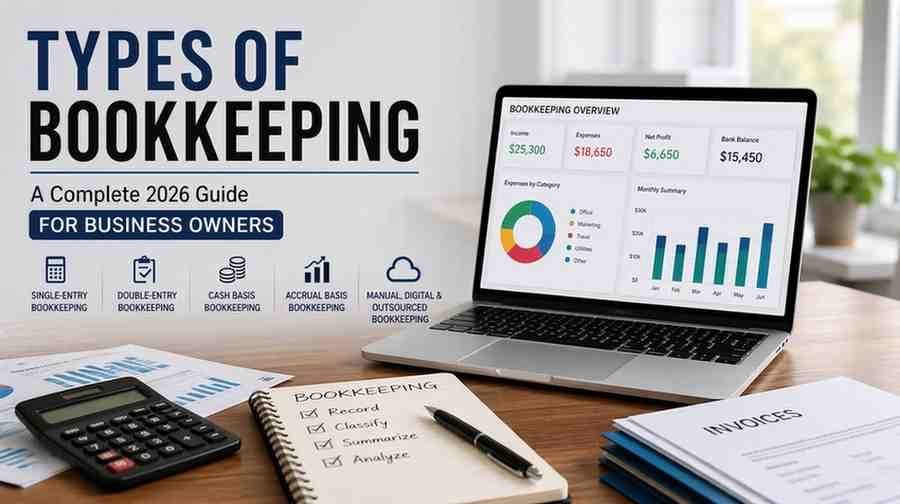
What are the main types of bookkeeping? The main types of bookkeeping and accounting are: Single-entry bookkeeping, Double-entry bookkeeping, Cash basis bookkeeping, Accrual basis bookkeeping, Manual bookkeeping, Computerized bookkeeping, Virtual or outsourced bookkeeping.
The most common type is single-entry bookkeeping, where each transaction is recorded only once, typically as either income or expense. The system provides basic functionality that works most effectively for small businesses and personal business operations.
Double-entry bookkeeping requires multiple accounts to be affected by each transaction through its debit and credit system. Most businesses use this system because it provides better financial recordkeeping through its complete record maintenance.
The timing of bookkeeping activities establishes a second classification system for bookkeeping. Cash-basis bookkeeping records transactions only when money is received or paid, while accrual bookkeeping records income and expenses when they are earned or spent, even if the cash has not yet been transferred.
Bookkeeping work can be carried out through three distinct methods: manual bookkeeping, spreadsheet usage, modern software, and outsourced services. The right type depends on the size and complexity of the business.
Table of Contents
Why does Bookkeeping Decide if a Business Survives?
Bookkeeping establishes a system for recording, classifying, and summarizing all financial transactions that a company executes. The accounting does not describe this process. Bookkeepers create the raw financial data; accountants interpret that data for tax strategy, audits, and executive decisions.
The stakes are high. The U.S. Small Business Administration has identified poor financial recordkeeping as a leading reason why small businesses fail. The Internal Revenue Service requires businesses to keep accurate financial records under federal tax laws. If you fail to comply, it may result in penalties, disallowed deductions, and even an audit.
Good bookkeeping does three things:
- Keeps you legal
- Shows your real cash position
- Gives you numbers to make decisions before problems explode.
This guide breaks down every major type of bookkeeping, with data on when to use each, pros/cons, and compliance rules for 2026.
Quick Comparison of Bookkeeping Types
| Type | Best For | Complexity | Accuracy |
|---|---|---|---|
| Single-entry | Freelancers | Low | Low |
| Double-entry | Businesses | High | High |
| Cash basis | Small business | Low | Medium |
| Accrual basis | Large business | High | High |
| Manual | Very small setups | Low | Low |
| Software | Growing businesses | Medium | High |
| Outsourced | Scaling companies | Medium | Very High |
Types of Bookkeeping by Entry System
1. Single-Entry Bookkeeping
Definition:
Each financial event is recorded once, usually as either income or expense. It works like a personal checkbook register. There is no attempt to balance assets against liabilities.
Mechanics:
The core tool is a cash book with five columns: Date, Description, Income, Expense, and Running Balance. You add income, subtract expenses, and track the balance. That’s it.
Example:
| Date | Description | Income | Expense | Balance |
|---|---|---|---|---|
| April 10, 2026 | Client payment – Logo design | $400 | $400 | |
| April 11, 2026 | Canva subscription | $15 | $385 | |
| April 12, 2026 | Paid freelancer | $100 | $285 |
Advantages:
- Simplicity: A 30-minute YouTube tutorial is enough training.
- Cost: Free if you use a notebook or Google Sheets.
- Speed: Best for businesses with fewer than 50 transactions per month.
Disadvantages:
- No error detection: If you mistype $400 as $40, nothing alerts you. The books won’t “fail to balance” because they never balance.
- Incomplete picture: You cannot produce a balance sheet. You don’t formally track Accounts Receivable, Accounts Payable, or Inventory.
- Not GAAP/IFRS compliant: Lenders and investors will reject these books for loans or due diligence.
- Tax risk: Easy to under-report income or miss deductions because there’s no second check.
Who should use it:
Freelancers, sole proprietors, and side hustlers with 100% cash transactions, no inventory, and no employees. Once you extend credit to customers or hold stock, single-entry becomes dangerous.
2. Double-Entry Bookkeeping
Definition:
Every transaction affects at least two accounts. For every debit, there is an equal and opposite credit. The system is built on the accounting equation:
Assets = Liabilities + Owner’s Equity.
History:
Formalized by Luca Pacioli in 1494 in Summa de Arithmetica. It’s been the global standard for 530 years because the math catches errors.
Mechanics:
There are 5 account types. Debits increase Assets and Expenses. Credits increase Liabilities, Equity, and Revenue.
- Asset up = Debit.
- Asset down = Credit.
- Liability up = Credit
- Liability down = Debit
Example:
You sell a $500 product that costs you $300, and the customer pays cash.
- Debit Cash $500, Credit Sales Revenue $500
- Debit Cost of Goods Sold $300, Credit Inventory $300
If you forget the second entry, your trial balance won’t balance. That’s the built-in error check.
Advantages:
- Accuracy: If debits are not equal to credits, you know there is an error.
- Complete reporting: You can produce profit and loss, balance sheet, and cash flow statement.
- Compliance: Required under Generally Accepted Accounting Principles and International Financial Reporting Standards. Required for audits.
- Scalability: Handles inventory, loans, depreciation, accruals, and multiple currencies.
Cons:
- Complexity: Requires understanding of debits, credits, and the chart of accounts.
- Time: Manual double-entry is slow. Almost always needs software in 2026.
- Cost: Software runs $15–$200/month. Training a bookkeeper costs more.
Who should use it:
Any business with inventory, employees, credit sales, bank loans, or plans to scale. In practice, if you are registered for sales tax in the US, the IRS (or State Department of Revenue) expects reconciled books, which means maintaining a double-entry accounting system.
Cash vs Accrual Bookkeeping Types
1. Cash Basis Bookkeeping
Definition:
You should record income when cash first arrives in your bank account. You should record expenses after you make the payment. The system tracks expenses through cash transactions, which operate independently of work completion.
IRS Rule 2026:
You can apply cash basis accounting if your business had an average yearly gross income that did not exceed 30 million dollars during the last three years. Some businesses that operate as tax havens have special rules that apply to them. The Income Tax Ordinance of Pakistan permits individuals and AOPs with basic financial operations to use cash basis accounting, whereas companies must implement accrual accounting.
Example:
The completion date of your project occurs on March 28, but the client makes payment on April 15. The cash basis accounting system shows no revenue for March, while it reports $5,000 for April.
Advantages:
- You can push your tax liability to next year because you can choose to send your December invoices in January.
- Your financial records reflect your actual cash situation, which helps you avoid bank overdrafts.
- The system requires no financial tracking because it does not need users to monitor accounts for money they owe or money that they will receive.
Disadvantages:
- Distorted profitability: A busy month where clients pay late looks like a loss. A slow month with old invoices collected looks like a windfall.
- No GAAP compliance: Banks and investors want accrual statements.
- Poor for inventory businesses: Buying $50,000 of stock in December shows a huge loss, even if you haven’t sold it.
Best for:
Service businesses, consultants, and retailers who get paid immediately.
2. Accrual Basis Bookkeeping
Definition:
Record revenue when it is earned and expenses when they are incurred, regardless of when cash moves.
Required Accounts:
To do accruals, you must track Accounts Receivable, Accounts Payable, Prepaid Expenses, Unearned Revenue, and Accrued Liabilities.
Example:
Same $5,000 project finished March 28, paid April 15. Accrual books show $5,000 revenue in March and create Accounts Receivable of $5,000. In April, you debit Cash and credit Accounts Receivable.
Advantages:
- Accurate performance: Matches revenue to the work done and expenses to the revenue they generated. This is the “matching principle.”
- Required by GAAP/IFRS: Mandatory for C-corporations, public companies, and businesses over $30M revenue in the US.
- Better decisions: You see profitability trends without cash timing noise.
Disadvantages:
- Cash-flow disconnect: You can be “profitable” on paper but have no cash because customers haven’t paid.
- Complexity: Requires adjusting entries and monthly closes. Usually needs a trained bookkeeper.
- Tax: You may owe tax on income you haven’t collected yet.
Best for:
Businesses with inventory, credit terms, subscriptions, or external funding.
Modified Cash Basis / Hybrid:
Many SMBs run accrual for management reports but convert to cash for tax. This is legal if you apply it consistently and disclose it.
Quick Comparison Table:
| Factor | Cash Basis | Accrual Basis |
|---|---|---|
| Revenue recorded | When cash received | When earned |
| Expense recorded | When cash paid | When incurred |
| GAAP compliant | No | Yes |
| Best cash visibility | High | Medium |
| Best profit accuracy | Low | High |
| Complexity | Low | High |
| Typical user | Freelancer, small retail | Growing SMB, corps |
Manual vs Digital Bookkeeping Systems
1. Manual Bookkeeping
Tools:
The system uses Paper ledgers and journals together with green accounting pads and Excel or Google Sheets templates.
Process:
The process requires hand-written entries, manual column totalization, and complete bank statement reconciliation and paper receipt storage in folders.
Data point:
A 2023 Intuit survey found that only 7% of US small businesses still use pure manual books. Main reasons: owner is 60+ or business has <12 transactions/month.
Pros and Cons
- Pros:
- The service requires no subscription fees.
- The system remains operational during software failures.
- The system requires the owner to verify all financial data through direct examination.
- Cons:
- University of Hawaii research found that 33 percent of manual spreadsheets contain at least one mistake.
- The system lacks automation and backup solutions, while it requires excessive time and physical records face the danger of destruction through fire or flood.
2. Computerized (online software) Bookkeeping
Tools:
The system uses QuickBooks Online, Xero, Zoho Books, Wave, and FreshBooks. Market leader QuickBooks has 80%+ SMB share in the US.
Please contact us if you need any kind of bookkeeping services.
Important features:
- Bank feeds: The system enables automatic transaction imports from your bank through an API connection.
- AI categorization: The software recommends “Office Supplies” as the appropriate category for Staples purchases based on past buying patterns.
- Real-time reporting: The P&L and Balance Sheet receive immediate updates throughout the day.
- Integrations: The system establishes connections to POS systems, e-commerce platforms, payroll systems, and tax software.
- Audit trail: The system records every modification together with the date and time and user identification.
Cost:
The service offers Wave for free and charges QuickBooks Advanced users $200 every month. The average SMB incurs monthly expenses between $35 and $60.
Pros and Cons
- Pros:
- 10x faster than manual, 90% fewer math errors, cloud backup, and access for your accountant.
- Cons:
- Garbage-in-garbage-out. If you mis-categorize transactions, reports are wrong. Subscription cost and learning curve.
3. Virtual / Outsourced Bookkeeping
Model:
You scan receipts or connect your bank. A remote firm or freelancer logs in, categorizes, reconciles, and sends monthly reports. Examples: Bench, Pilot, Merit Bookkeeping.
Pricing 2026:
Tiered by expense volume. $200-$349/month for <$60k annual expenses. $500-$2,500/month for complex businesses.
Pros and Cons
- Pros:
- CPA-level accuracy without hiring full-time staff. Frees 5-10 hours/month of owner time. Stays current on tax law changes.
- Cons:
- Less immediate control. You must check for data security – they have access to the bank. Communication delays if they are in different time zones.
Trend:
“Bookkeeping as a Service” grew 22% from 2023 to 2025 per Gartner, driven by AI reducing labor costs.
Business Function-Based Classification System
The expansion of business operations leads to the creation of distinct bookkeeping positions for their financial management needs.
1. Full-charge bookkeeper
A full-charge bookkeeper handles all accounting tasks except tax filing and audit processes. They perform A/P and A/R tasks while also managing payroll and bank reconciliation work to generate trial balance results. This position exists in businesses that employ between five and fifty staff members.
2. Accounts Receivable Bookkeeping
The Accounts Receivable Bookkeeping system handles customer billing and payment monitoring, together with production of aging reports and debt collection tasks. The main performance indicator for the system tracks Days Sales Outstanding. Most industries operate with DSO values that fall below 45 as a standard requirement.
3.Accounts Payable Bookkeeping
Accounts Payable Bookkeeping controls the process of handling vendor payments through management of bill processing and due date tracking, early payment discount assessment, and 1099 documenting. The system uses a 3-way match control, which requires matching purchase orders with received items and received invoices to detect fraudulent activities.
4. Payroll Bookkeeping
Payroll Bookkeeping functions as the most controlled segment. The system manages employee earnings together with tax deductions and EOBI/Social Security benefits, and organizational compliance with labor regulations. The system generates government penalties for mistakes because it operates at a high speed. Businesses usually contract payroll services to Gusto, ADP, and local payroll service providers.
5. Inventory Bookkeeping
Inventory Bookkeeping system monitors inventory quantities together with the expenses linked to items sold. The system operates through two methods because it uses a perpetual system, which updates inventory with every sale through point of sale, and a periodic system, which conducts stock checks at monthly and quarterly intervals. The company uses FIFO, LIFO, and Weighted Average as its valuation methods. The selected method affects both tax obligations and profit calculations.
6. Tax Bookkeeping
Tax Bookkeeping exists as a specialized system that needs special attention. The system requires tagging transactions to prepare for sales tax, GST, VAT, and income tax deduction processing. The system needs to maintain separate records for Meals and Client Entertainment because the deduction rules for each expense category differ.
Top 5 Mistakes
- Not tracking cash: Petty cash and owner cash payments get forgotten.
- Booking loans as income: Loan proceeds are a liability, not revenue. This error overstates profit and tax.
- Ignoring the balance sheet: Owners look only at P&L. Meanwhile, A/R is 120 days old, and cash is gone.
- DIY payroll: Tax penalties for late payroll deposits are steep and non-negotiable.
- No data hygiene: Descriptions like “Paid stuff” make year-end tax work a nightmare.
Conclusion
There is no single “best” type of bookkeeping. There is only one type that suits your size, complexity, and legal requirements at this time. Start with the simplest system that keeps you compliant and shows you cash truth. Upgrade the moment your business adds inventory, credit, or staff.
Review your system every 12 months. If you’re closing loans, taking investors, or registering for sales tax, you must be on double-entry accrual. If you’re a solo consultant paid upfront, a cash basis in software is fine.
Bad bookkeeping kills businesses quietly. Good bookkeeping tells you’re dying while you still have time to fix it. Pick a type and do it well.
Frequently Asked Questions
Which type of bookkeeping is best?
Double-entry bookkeeping is generally the best choice for most businesses because it provides accurate financial records.
What is the easiest bookkeeping method?
Single-entry bookkeeping is the simplest method for beginners.
Do small businesses need double-entry bookkeeping?
Yes, especially if they have inventory, employees, or loans.