
All businesses need bookkeeping because it serves as their main support system. Students, freelancers, and business owners need to study bookkeeping formulas because this knowledge helps them control their finances and make better financial choices.
Table of Contents
This guide presents essential bookkeeping formulas, which the author demonstrates through straightforward explanations and practical examples. The research shows how financial data operates within actual business environments.
What Are Bookkeeping Formulas (Accounting Formulas)?
Bookkeeping formulas are mathematical equations used to record, analyze, and manage your financial transactions. These formulas help calculate profit, expenses, assets, and overall financial health.
The bookkeeping process requires formulas because they serve as essential components for creating complete and precise records.
Small Business Bookkeeping Formulas
| Formula Name | Formula |
|---|---|
| Profit | Revenue − Expenses |
| Gross Profit | Revenue − COGS |
| Net Profit | Gross Profit − Expenses |
| Revenue | Price × Quantity |
| Equity | Assets − Liabilities |
| Cash Flow | Inflows − Outflows |
| ROI | (Profit ÷ Investment) × 100 |
| Break-even | Fixed Cost ÷ Contribution |
Why Bookkeeping Formulas Are Important in Accounting
Bookkeeping formulas help you:
- Track income and expenses
- Understand profit and loss
- Make better financial decisions
- Maintain accurate financial records
- Avoid accounting errors
Both small businesses and large enterprises need these formulas to operate their financial systems.
Basic Accounting Formula
The most important formula in bookkeeping is:
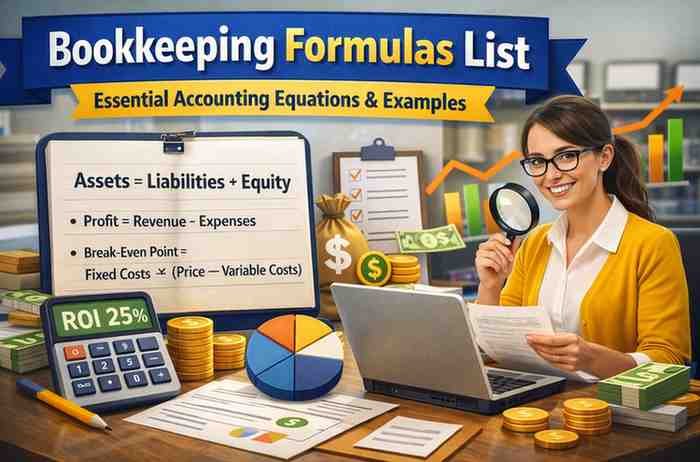
Assets = Liabilities + Equity
Example:
- Assets = $10,000
- Liabilities = $4,000
- Equity = $6,000
This formula ensures that your books are always balanced.
Profit and Loss Formulas
These are the most commonly used formulas in bookkeeping and accounting.
1. Profit Formula
Profit = Revenue − Expenses
Example:
- Revenue = $5,000
- Expenses = $3,000
Profit = $2,000
2. Loss Formula
Loss = Expenses − Revenue
Example:
- Expenses = $4,000
- Revenue = $2,500
Loss = $1,500
If expenses are higher than revenue, the result is a loss.
3. Gross Profit Formula
Gross Profit = Revenue − Cost of Goods Sold (COGS)
Example:
- Revenue = $8,000
- COGS = $5,000
Gross Profit = $3,000
4. Net Profit Formula
Net Profit = Gross Profit − Expenses
Example:
- Gross Profit = $3,000
- Expenses = $1,000
Net Profit = $2,000
5. Profit Percentage Formula
Profit % = (Profit ÷ Cost Price) × 100
Example:
- Profit = $200
- Cost Price = $1,000
Profit % = 20%
Revenue and Expense Formulas
1. Total Revenue Formula
Total Revenue = Selling Price × Quantity
Example:
- Price = $20
- Quantity = 100
Revenue = $2,000
2.Total Expense Formula
Total Expenses = Fixed Expenses + Variable Expenses
Example:
- Fixed Expenses = $2,000
- Variable Expenses = $1,500
Total Expenses = $3,500
3. Net Income Formula
Net Income = Total Revenue − Total Expenses
Example:
- Revenue = $5,000
- Expenses = $3,500
Net Income = $1,500
This shows the actual earnings of a business.
Balance Sheet Formulas
Balance sheet formulas help you understand financial position.
1. Equity Formula
Equity = Assets − Liabilities
Example:
- Assets = $12,000
- Liabilities = $5,000
Equity = $7,000
2. Working Capital Formula
Working Capital = Current Assets − Current Liabilities
Example:
- Current Assets = $8,000
- Current Liabilities = $3,000
Working Capital = $5,000
3. Current Ratio Formula
Current Ratio = Current Assets ÷ Current Liabilities
Example:
- Current Assets = $6,000
- Liabilities = $3,000
Current Ratio = 2
Cash Flow Formulas
1.Cash Flow Formula
Cash Flow = Cash Inflows − Cash Outflows
Example:
- Inflows = $7,000
- Outflows = $4,000
Cash Flow = $3,000
This shows short-term financial strength.
2. Operating Cash Flow Formula
Operating Cash Flow = Net Income + Non-Cash Expenses
Example:
- Net Income = $2,000
- Depreciation = $500
Operating Cash Flow = $2,500
If the ratio is above 1, the business is financially stable.
Cost Calculation Formulas
1. Cost Price Formula
Cost Price = Purchase Price + Additional Costs
Example:
- Purchase Price = $800
- Additional Costs = $200
Cost Price = $1,000
2. Selling Price Formula
Selling Price = Cost Price + Profit
Example:
- Cost Price = $1,000
- Profit = $200
Selling Price = $1,200
3. Break-Even Formula
Break-even Point = Fixed Costs ÷ (Selling Price − Variable Cost)
Example:
- Fixed Costs = $2,000
- Selling Price = $50
- Variable Cost = $30
Break-even = 100 units
This tells when your business starts making profit.
Advanced Bookkeeping Formulas
1. Return on Investment (ROI)
ROI = (Net Profit ÷ Investment) × 100
Example:
- Net Profit = $500
- Investment = $2,000
ROI = 25%
2. Debt to Equity Ratio
Debt to Equity = Total Liabilities ÷ Equity
Example:
- Liabilities = $6,000
- Equity = $3,000
Debt to Equity = 2
3. Inventory Formula
Ending Inventory = Beginning Inventory + Purchases − Sales
Example:
- Beginning Inventory = $2,000
- Purchases = $5,000
- Sales = $4,000
Ending Inventory = $3,000
4. Depreciation Formula
Depreciation = (Asset Cost − Salvage Value) ÷ Useful Life
Example:
- Asset Cost = $10,000
- Salvage Value = $2,000
- Useful Life = 4 years
Depreciation = $2,000 per year
5. Contribution Margin Formula
Contribution Margin = Sales − Variable Costs
Example:
- Sales = $5,000
- Variable Costs = $3,000
Contribution Margin = $2,000
6. Contribution Margin Ratio
Contribution Margin Ratio = (Contribution Margin ÷ Sales) × 100
Example:
- Contribution Margin = $2,000
- Sales = $5,000
Ratio = 40%
7. Markup Formula
Markup = (Profit ÷ Cost Price) × 100
Example:
- Profit = $50
- Cost Price = $200
Markup = 25%
8. Margin Formula
Profit Margin = (Profit ÷ Revenue) × 100
Example:
- Profit = $200
- Revenue = $1,000
Margin = 20%
9. Accounts Receivable Turnover
AR Turnover = Net Credit Sales ÷ Average Accounts Receivable
- Net Credit Sales = $10,000
- Avg Receivable = $2,000
Turnover = 5 times
10. Accounts Payable Turnover
AP Turnover = Total Purchases ÷ Average Accounts Payable
Example:
- Purchases = $8,000
- Avg Payable = $2,000
Turnover = 4 times
11. Inventory Turnover Formula
Inventory Turnover = COGS ÷ Average Inventory
Example:
- COGS = $6,000
- Avg Inventory = $2,000
Turnover = 3 times
12. Average Inventory Formula
Average Inventory = (Beginning Inventory + Ending Inventory) ÷ 2
Example:
- Beginning = $1,000
- Ending = $3,000
Average = $2,000
13. Operating Profit Formula
Operating Profit = Gross Profit − Operating Expenses
Example:
- Gross Profit = $4,000
- Expenses = $1,500
Operating Profit = $2,500
14. Net Sales Formula
Net Sales = Gross Sales − Returns − Discounts
Example:
- Gross Sales = $10,000
- Returns = $500
- Discounts = $500
Net Sales = $9,000
15. Cost of Goods Manufactured (COGM)
COGM = Total Manufacturing Cost + Opening Inventory − Closing Inventory
Example:
- Cost = $7,000
- Opening = $1,000
- Closing = $2,000
COGM = $6,000
16. Fixed Cost Formula
Fixed Cost = Total Cost − Variable Cost
Example:
- Total Cost = $10,000
- Variable Cost = $6,000
Fixed Cost = $4,000
17. Variable Cost Formula
Variable Cost = Total Cost − Fixed Cost
Example:
- Total Cost = $10,000
- Fixed Cost = $4,000
Variable Cost = $6,000
18. Average Cost Formula
Average Cost = Total Cost ÷ Quantity
Example:
- Total Cost = $5,000
- Quantity = 100
Average Cost = $50
19. Earnings Per Share (EPS)
EPS = Net Income ÷ Number of Shares
Example:
- Net Income = $10,000
- Shares = 2,000
EPS = $5
20. Quick Ratio Formula
Quick Ratio = (Current Assets − Inventory) ÷ Current Liabilities
Example:
- Current Assets = $10,000
- Inventory = $2,000
- Liabilities = $4,000
Quick Ratio = 2
21. Debt Ratio Formula
Debt Ratio = Total Liabilities ÷ Total Assets
Example:
- Liabilities = $5,000
- Assets = $10,000
Debt Ratio = 0.5
22. Capital Turnover Formula
Capital Turnover = Sales ÷ Capital Employed
Example:
- Sales = $20,000
- Capital = $10,000
Turnover = 2
23. Gross Margin Formula
Gross Margin = (Gross Profit ÷ Revenue) × 100
Example:
- Gross Profit = $2,000
- Revenue = $8,000
Margin = 25%
24. Net Profit Margin Formula
Net Profit Margin = (Net Profit ÷ Revenue) × 100
Example:
- Net Profit = $1,500
- Revenue = $10,000
Margin = 15%
Conclusion
The bookkeeping formulas list provides essential knowledge that enables people to handle their financial responsibilities with competence. These formulas help you calculate profit, track expenses, and analyze business performance.
Students, bookkeepers, and business owners need to learn these formulas because they establish a core understanding of financial knowledge.
FAQs (Short Answers)
What is the basic bookkeeping formula?
Assets = Liabilities + Equity.
How do you calculate profit?
Profit = Revenue − Expenses.
What is net profit?
Net profit is total earnings after all expenses.
What is the revenue formula?
Revenue = Price × Quantity.
Why are bookkeeping formulas important?
They help track and manage financial data accurately.